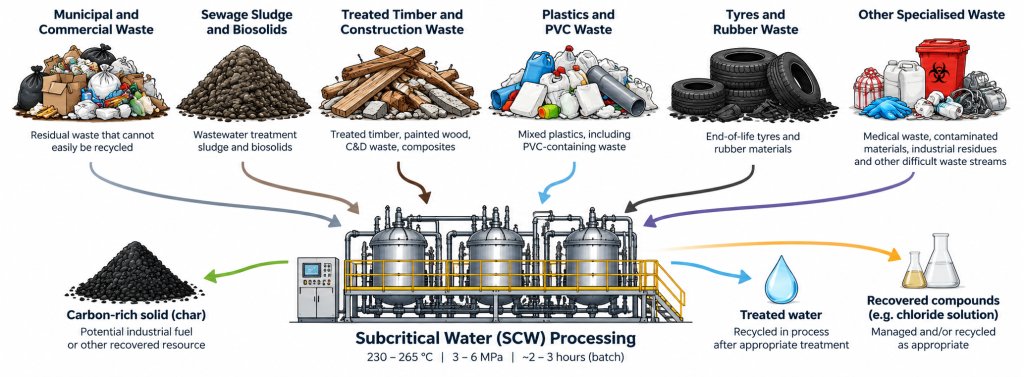
Subcritical Water (SCW) processing offers a different approach to managing waste materials that are difficult, expensive or environmentally challenging to dispose of. Rather than simply transporting these materials to landfill, SCW uses pressurised hot water to transform their physical and chemical characteristics, potentially recovering useful resources in the process.
The technology has been used commercially in Japan for applications involving municipal, medical and industrial waste. Recycling Oceania is now investigating its suitability for a wider range of waste streams in New Zealand and across Oceania.
Not every application has been commercially demonstrated, and different waste materials require different processing conditions. Our approach is to build on Japan’s operating experience, undertake independent testing where necessary and evaluate each application on its technical, environmental and commercial merits.
Municipal and Commercial Waste
Municipal and commercial waste often contains a mixture of materials that cannot readily be recycled, including contaminated paper, plastics, textiles, food residues and other organic materials.
Subcritical Water processing offers an alternative treatment pathway for suitable residual waste, reducing the quantity requiring disposal while recovering a carbon-rich solid with potential value as an industrial fuel.
Commercial installations in Japan provide operating experience with mixed waste streams. For New Zealand, the opportunity is to evaluate how SCW could complement existing recycling and resource-recovery systems, rather than replace them.
Actual processing performance, material recovery and economics would need to be established for the specific waste stream.
Sewage Sludge and Biosolids
Sewage sludge presents a significant challenge for wastewater treatment operators. Even after mechanical dewatering, sludge retains substantial moisture and can be expensive to transport, dry and dispose of. Subcritical Water processing offers a different approach because it can treat wet organic materials without the extensive preliminary drying required by some conventional thermal technologies.
Japan has already demonstrated the commercial application of Subcritical Water technology to sewage sludge. These installations provide valuable operating experience in processing wet organic materials and recovering useful products.
Depending on the sludge composition and operating conditions, SCW processing can substantially reduce the quantity of solid material requiring disposal. The resulting carbon-rich material may have potential as an industrial fuel or other recovered resource, subject to testing and environmental requirements.
For New Zealand & Oceania based wastewater operators, the opportunity is significant. Rather than continually transporting large quantities of wet sludge to disposal facilities, SCW could provide an alternative treatment pathway, potentially reducing transport requirements, disposal costs and environmental impacts. Each project would require assessment of sludge characteristics, energy consumption, contaminants and the intended use of the recovered material.
Treated Timber and Construction Waste
Construction and demolition waste presents a particular challenge because it often contains materials that are difficult to recycle or dispose of safely. Treated timber, painted wood, plastics, adhesives and composite materials can complicate conventional recovery processes, with substantial quantities ultimately ending up in landfill.
Subcritical Water processing provides a practical treatment pathway for treated timber and other suitable construction and demolition waste. Under elevated temperature and pressure, the process breaks down the organic components of timber, producing a carbon-rich solid with potential value as an industrial fuel. This creates an opportunity to recover energy from materials that would otherwise be discarded.
Treated timber requires particular attention because preservatives may contain copper, chromium and arsenic. Unlike conventional combustion, SCW treatment takes place in a sealed, pressurised reactor without directly burning the waste. The resulting solids and process water can therefore be collected and assessed separately. The distribution, chemical form and stability of preservative metals must be established through appropriate testing before recovered materials are put to use.
Recycling Oceania is working to establish commercial applications for SCW processing of treated timber and construction waste in New Zealand and across Oceania. The objective is to divert suitable materials from landfill, substantially reduce waste volumes and recover their energy value.
Independent testing will focus on processing performance, the behaviour of preservative metals, the quality of the resulting char and its suitability as an industrial fuel. Potential applications include supplying recovered fuel to cement manufacturers and other industrial energy users, subject to their technical specifications and environmental requirements.
Plastics and PVC Waste
Subcritical Water (SCW) technology has been used commercially in Japan for more than 20 years, including the processing of municipal waste streams containing plastics. Historical laboratory reports from Japanese facilities document the composition of these waste streams, the chlorine content of recovered materials and their potential value as industrial fuels.
PVC presents a particular challenge because of its chlorine content. During SCW processing, chlorine-containing compounds can undergo chemical reactions that release chlorine into the aqueous phase, where it can be managed through appropriate water-treatment systems. The extent of chlorine removal depends on the material and processing conditions.
For Recycling Oceania, the opportunity is to build on this Japanese operating experience to process difficult-to-recycle plastics, including PVC-containing waste, while recovering useful energy from suitable products. Each proposed application would require appropriate testing of the recovered material, chlorine distribution and process water.
Tyres and Rubber Waste
End-of-life tyres present a significant waste-management challenge because they contain a complex mixture of natural rubber, synthetic rubber, carbon black, steel and other additives. Their durability makes them useful products, but also difficult to process and recover.
Subcritical Water processing offers a potential alternative for recovering resources from tyres and other rubber-based materials. Under elevated temperature and pressure, the process can break down certain organic components and alter the physical structure of the rubber.
Initial tyre-processing trials conducted by Mr Kaneo Ishimori have demonstrated promising results. At approximately 28 bar, synthetic components were reduced to powder, while portions of the vulcanised rubber remained as small, rounded pieces approximately 4.5 cm in diameter.
These results indicate that higher operating pressures may be necessary to achieve more complete breakdown of vulcanised rubber. Further development and testing at pressures above 53 bar are being pursued.
For Recycling Oceania, tyre processing represents a potential future application rather than an established commercial operation. Further trials will be required to determine processing performance, energy consumption, recovered material characteristics and commercial viability.
Other Potential Applications and Future Development
Subcritical Water technology may also offer opportunities for processing other difficult waste streams, including contaminated organic materials, selected industrial residues and waste recovered from existing landfills.
Some of these applications have been investigated in Japan, while others require further development and testing. The suitability of SCW processing depends on the composition of the waste, operating conditions and the management of recovered materials.
Recycling Oceania welcomes opportunities to evaluate new applications, working with waste operators, researchers and industrial partners to establish technical performance, environmental outcomes and commercial feasibility.