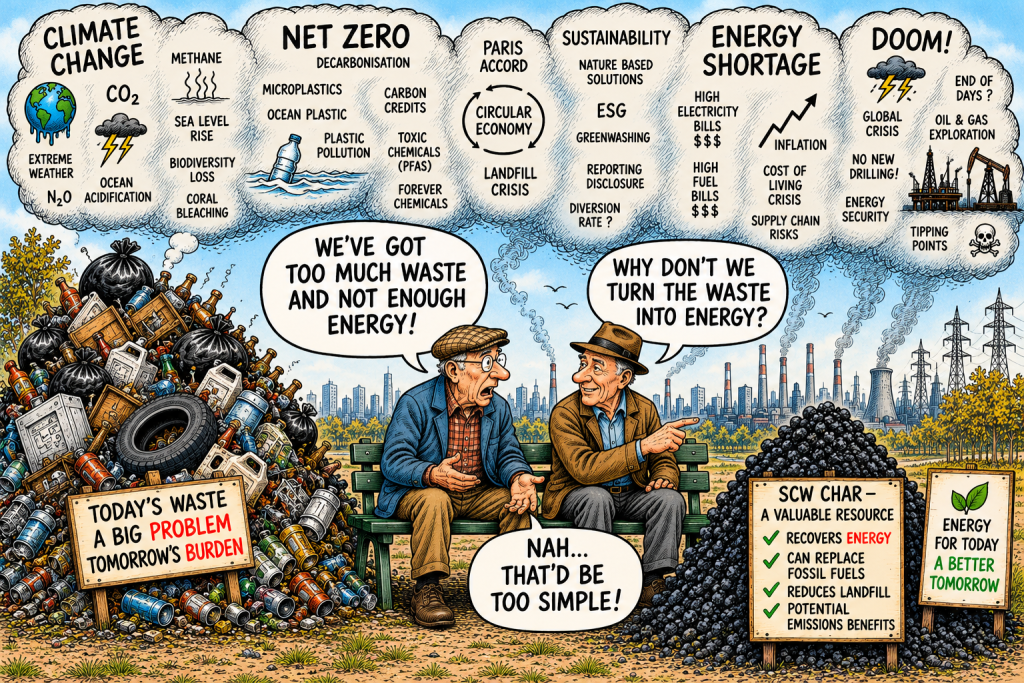
At Recycling Oceania, we believe that much of what we currently send to landfill still has value.
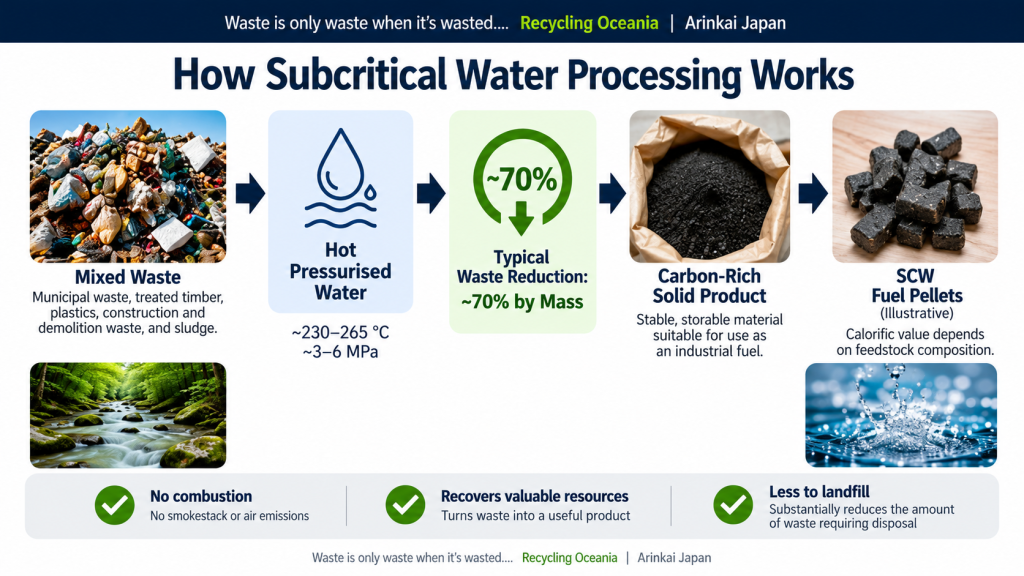
For more than 20 years, Subcritical Water (SCW) technology has been used commercially in Japan to process difficult waste materials, substantially reduce their mass, and recover a carbon-rich material known as char.
Using hot, pressurised water rather than combustion, SCW can process a wide range of materials, including municipal waste, treated timber, plastics, construction and demolition waste, and wastewater sludge.
Our objective is to introduce this proven Japanese technology to New Zealand, working with councils, industry and research organisations to investigate practical alternatives to landfill disposal.
See Subcritical Water Technology in Action
This video shows a commercial Subcritical Water processing facility in Japan handling medical waste. Although the facility shown processes medical waste, SCW technology can also be applied to municipal waste, treated timber, plastics, construction and demolition waste, and wastewater sludge.
Video courtesy of the original YouTube publisher. New SCW videos are being planned and will be added when available.
SCW Processing Overview
Loading at a medical waste processing facility
Discharging SCW char following processing. Depending on the waste composition, SCW can reduce the original waste mass by approximately 70% — for example, one tonne of incoming waste may produce approximately 300 kg of solid char.
See more videos (in Japanese) here: https://arinkai.jp/movie.html
From Waste to Resources – The Commercial SCW Processing Journey
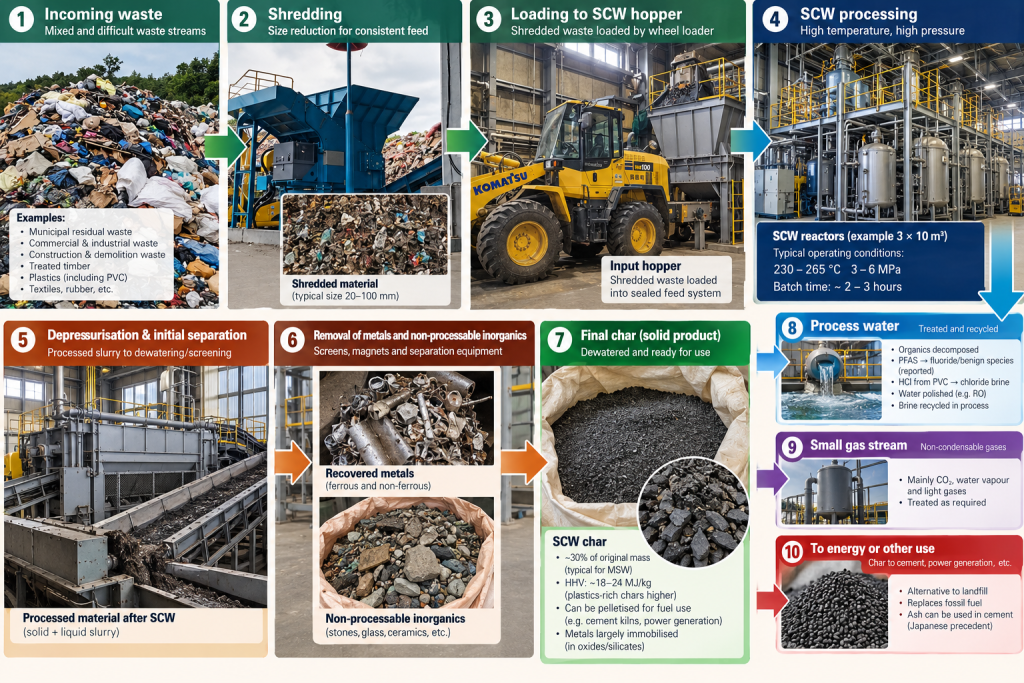
This overview shows how mixed and difficult waste streams can be processed using commercial-scale Subcritical Water (SCW) technology.
Incoming waste is first sorted to recover recyclable materials where practical, before the remaining material is shredded to a suitable size. A wheel loader transfers the prepared waste into the receiving hopper, from where it is fed into the SCW processing system. Inside the sealed reactors, high-temperature, high-pressure water and steam conditions break down and transform organic materials, substantially reducing the original waste mass.
Following processing, the resulting material undergoes separation and dewatering. Metals and non-processable inorganic materials, including glass, stones and ceramics that may have entered the system, are removed from the carbon-rich char.
The recovered char may then be used as an industrial fuel or for other suitable applications, subject to its composition, independent testing and relevant environmental requirements. Process water is treated for potential reuse, while gases and other residual streams are managed through appropriate treatment systems.
The objective is not to replace recycling, but to recover additional value from materials that would otherwise require disposal.
Note: This process overview is based on actual operations at the Shari SCW facility in Hokkaido, Japan, incorporating photographs taken at the facility and supplementary illustrations to show the complete processing sequence.
What Can Subcritical Water Process?
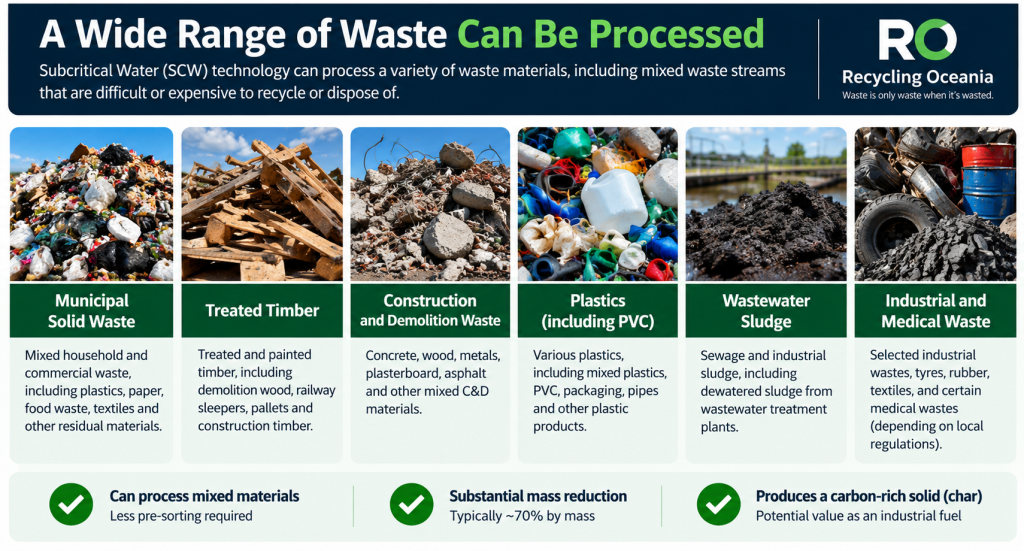
One of the major advantages of Subcritical Water (SCW) technology is its ability to process a wide range of waste materials, including mixed waste streams that are difficult or expensive to recycle or dispose of.
These include municipal solid waste, treated timber, construction and demolition waste, plastics (including PVC), wastewater sludge, and certain industrial and medical wastes.
Unlike conventional recycling, which often requires materials to be carefully separated, SCW can process suitable mixed materials together. This makes it particularly interesting for councils and waste operators dealing with residual waste after recyclable materials have been recovered.
The process substantially reduces the mass of waste and produces a carbon-rich solid known as char, which may have value as an industrial fuel, depending on its composition and testing.
Learn More About Our Japanese Technology Partner — Arinkai
Our connection with Japan
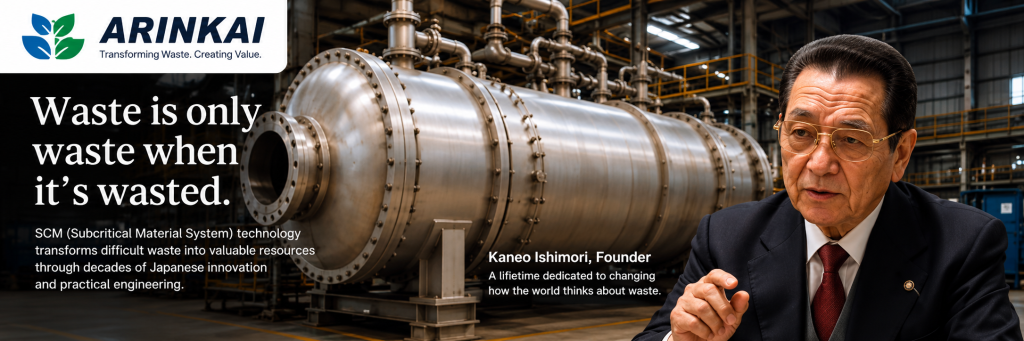
Recycling Oceania works with Arinkai in Japan to introduce Subcritical Water (SCW) technology to New Zealand.
At the heart of this technology is Mr Kaneo Ishimori, whose decades of research, development and practical engineering experience have contributed to the development of commercial SCW processing systems.
Unlike many emerging waste-treatment technologies, SCW has an established operational history in Japan. Commercial facilities have processed challenging waste streams for more than 20 years, providing valuable experience in the practical application of this technology.
Our role at Recycling Oceania is to connect this Japanese experience with opportunities in New Zealand, working alongside councils, waste-management companies, industry and independent research organisations.