
Proven Technology. Real Commercial Installations.
Subcritical Water (SCW) technology is not simply a laboratory concept. Systems developed by Kaneo Ishimori have been deployed commercially in Japan for more than 20 years, processing a variety of waste materials.
According to the Japanese technology developer, more than 40 SCM reactors have been deployed across different locations and applications, including municipal and industrial waste, medical waste and other specialised processing requirements.
These installations provide an important foundation for evaluating the technology in New Zealand. Rather than relying solely on theoretical performance, prospective users can examine actual equipment, operating experience and the results achieved with different waste streams.
Shari, Hokkaido — Commercial SCW Installation
Shari, a town in eastern Hokkaido, Japan, operates the Miraiaru Eco Clean Centre, where municipal waste is processed using high-temperature, high-pressure technology.
According to Shari Town Council’s official waste-management guide, general waste is converted into solid fuel. This recovered fuel is used in the facility’s own boiler and is also supplied to a steelworks elsewhere in Hokkaido.
The facility operates as part of an integrated municipal waste-management system. Food waste is separately composted, recyclable materials are recovered, and suitable combustible waste is processed into fuel.
Recycling Oceania has visited the Shari facility on numerous occasions, providing an opportunity to examine the commercial equipment and discuss its operation firsthand.
https://www.town.shari.hokkaido.jp/soshikikarasagasu/kankyoka/gomirisaikuru/321.html
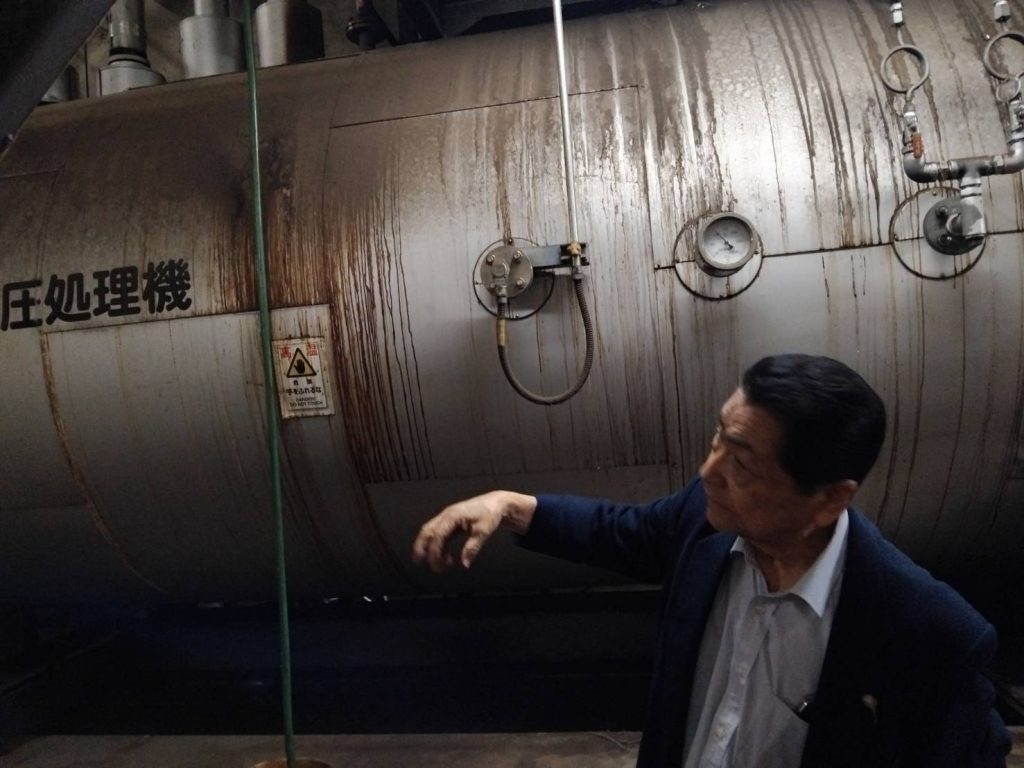
Mr Kaneo Ishimori beside a commercial Subcritical Water reactor at Shari, Hokkaido, Japan. Photograph: Recycling Oceania.
Other Commercial SCW Installations in Japan
Shari is not an isolated example. Since the early 2000s, SCM reactors developed in Japan have been supplied for a range of municipal, medical and industrial waste-processing applications.
The developer’s installation records identify projects across Hokkaido and Hiroshima, including facilities handling infectious medical waste, general commercial waste and other specialised materials. These records provide evidence of equipment deployment, although the operating status and performance of individual installations need to be considered separately.
- 2003 — Otaru, Hokkaido: 5 m³ reactor supplied for general commercial waste from a supermarket chain.
- 2005 — Mikasa, Hokkaido: 5 m³ reactor supplied for infectious medical waste.
- 2005 — Shari, Hokkaido: 5 m³ reactor listed in the developer’s medical-waste installation records.
- 2006 — Kushiro, Hokkaido: 5 m³ reactor supplied for medical waste.
- 2007 — Hokkaido: Five 13 m³ reactors recorded for a local-government general commercial waste application.
- 2010 — Hiroshima Prefecture: 5 m³ reactor supplied for infectious medical waste.