
Subcritical Water Processing — Turning Difficult Waste into Valuable Resources
Subcritical Water (SCW) processing uses water at elevated temperatures and pressures to transform waste materials without directly burning them.
Under these conditions, water behaves differently from the water we use every day. It can penetrate organic materials, accelerate chemical reactions and break down complex substances that are otherwise difficult to process.
The result is a substantial reduction in waste mass, with a carbon-rich solid material known as char recovered for potential use as an industrial fuel or other resource.
This is not simply a laboratory concept. SCW technology developed in Japan has been operating commercially for more than 20 years.
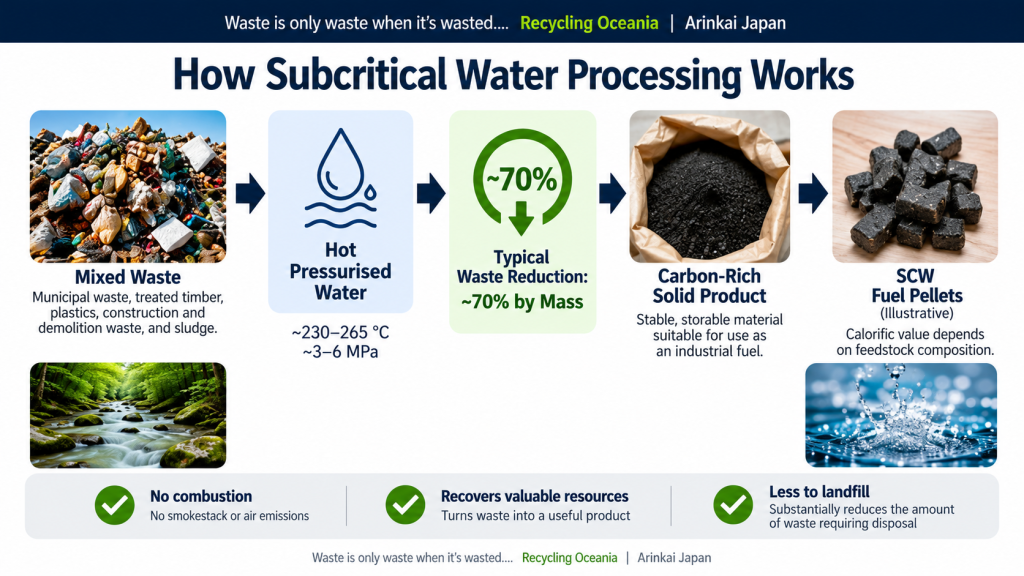
What Happens Inside the Reactor?
Waste material is loaded into a sealed steel reactor, where it is exposed to hot, pressurised water. Unlike incineration, the waste is not directly burned.
Under these conditions, water penetrates the material and helps break down complex organic structures. The process substantially reduces the mass of the original waste and produces a carbon-rich solid known as char.
The char can potentially be used as an industrial fuel, depending on its composition and the requirements of the end user. Water and other process outputs are managed through the plant’s treatment systems.
Commercial SCW Equipment and Operating Conditions
Commercial SCW Equipment
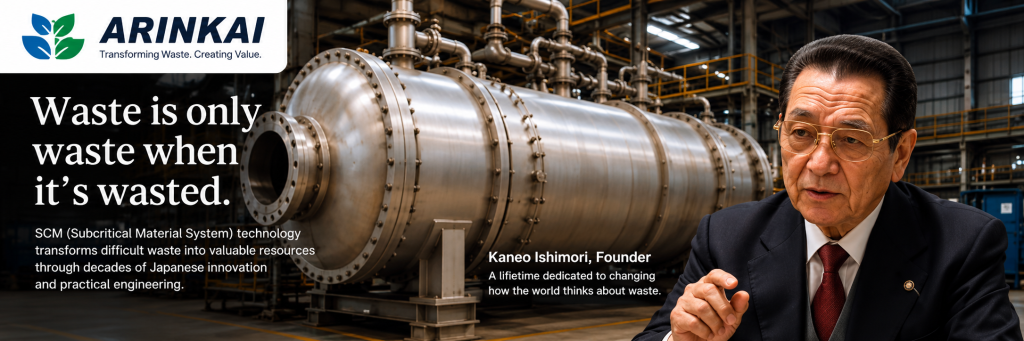
Subcritical Water (SCW) processing takes place inside specially engineered, high-pressure steel reactors. The technology developed by Kaneo Ishimori has been used commercially in Japan for more than 20 years. Typical operating temperatures range from approximately 230–265°C, with pressures of 3–6 MPa (30–60 bar). Actual operating conditions depend on the reactor design and the materials being processed. A standard commercial installation comprising three reactors can process more than 70 tonnes of waste per day, equivalent to approximately 25,000 tonnes annually. Additional reactors can be incorporated to accommodate larger waste volumes, allowing processing capacity to be scaled according to operational requirements.
Smaller, trailer-mounted systems are also available for applications requiring mobility or lower processing capacities. Unlike conventional incineration, waste is not directly burned inside the reactor. Instead, hot, pressurised water facilitates the breakdown and transformation of organic materials, substantially reducing the mass of waste while producing a carbon-rich solid known as char, which has potential applications as a recovered fuel or other useful resource.
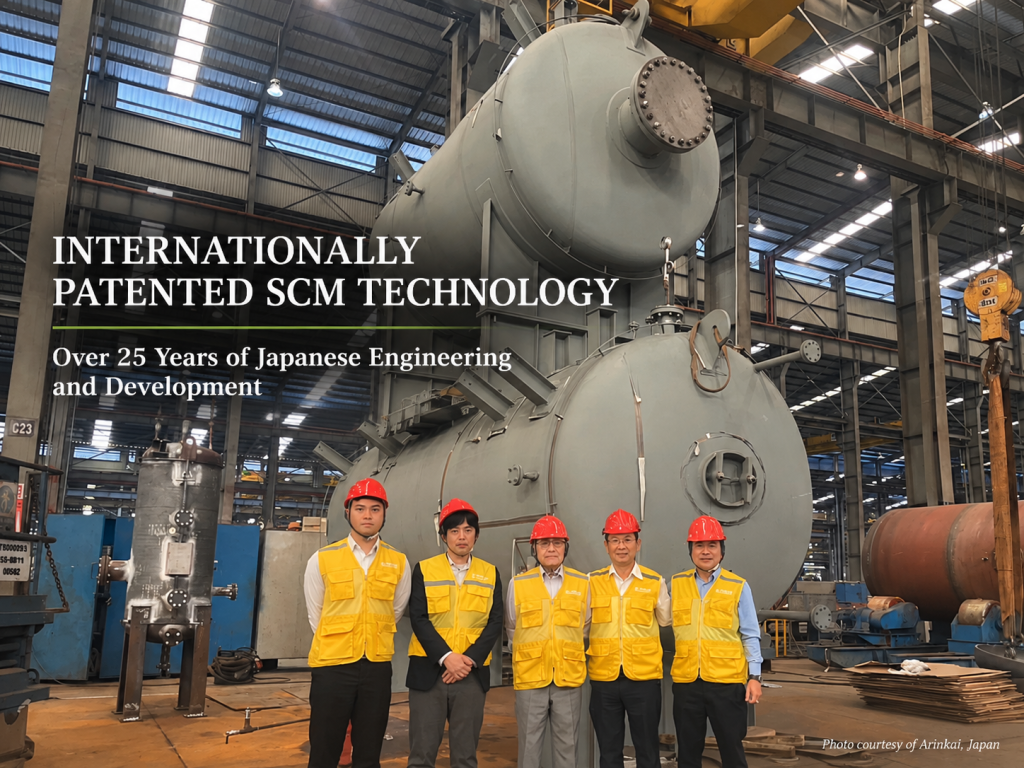
Large-scale SCM reactor equipment during fabrication in Japan. Original photograph courtesy of Arinkai; image adapted for Recycling Oceania.
Portable SCM Systems — Taking the Technology to the Waste
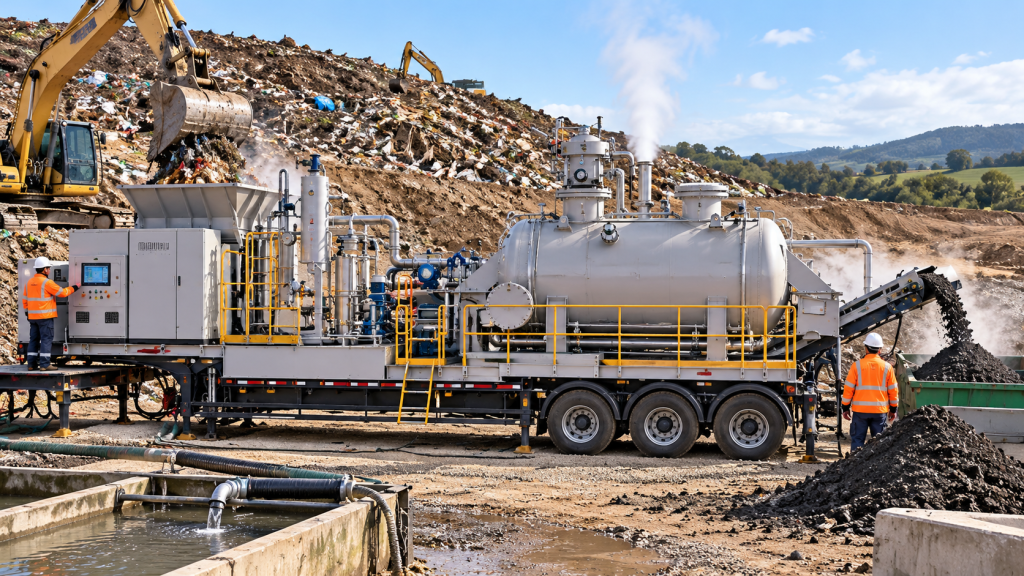
Unlike large, permanently installed SCW processing plants, portable SCM systems are designed to be transported to locations where waste needs to be processed. The portable system incorporates a smaller reactor mounted on a trailer, allowing it to be deployed at suitable industrial sites, waste-processing facilities or other locations where a permanent installation may not be practical. One proposed configuration uses a 3 m³ reactor, with an indicative processing capacity of approximately 2 tonnes per batch, depending on the material being treated. Multiple batches can be completed each day.
This approach could be particularly useful for regional waste streams, industrial waste, contaminated materials and projects where transporting waste over long distances is expensive or impractical.
What Comes Out of the SCW Process?
Subcritical Water processing transforms waste into several output streams. Their quantities and characteristics depend on the original waste material and the operating conditions.
1. Char — A Potential Energy Resource
The principal solid output is a carbon-rich material known as char. Depending on the waste composition, processing can reduce the original waste mass substantially, with reductions of around 70% reported for some mixed-waste applications.
Char can potentially be used as an industrial fuel, including in cement manufacturing and electricity generation. Its suitability depends on energy content, moisture, ash, chlorine, heavy metals and other characteristics that must be tested.
2. Process Water
Water plays a central role in the SCW process. After treatment, the liquid stream is separated and managed through the plant’s water-treatment systems.
Depending on its composition and treatment requirements, water may be recovered for reuse within the process. Any discharge must meet applicable environmental standards.
3. Recovered Materials and Other Residues
Metals, glass, minerals and other inorganic materials may remain after processing. Some may be suitable for recovery or recycling, while others require further treatment or appropriate disposal.
The composition of these residues must be assessed, particularly when processing contaminated or hazardous waste.
Inside the SCW Reactor – How Waste Becomes a Resource
What actually happens to waste when it is exposed to hot, pressurised water?
Subcritical Water (SCW) technology uses temperatures of 230–265°C and pressures of 3–6 MPa to break down complex organic materials without incineration.
But how does it work?
We’ve prepared a simple, illustrated presentation that takes you inside the SCW reactor, showing how mixed waste is processed, how complex molecules break down and reform, and how the resulting materials can be recovered as useful resources.
The presentation follows the process from loading the reactor through to the production of carbon-rich char, process water and a small amount of gas.
Take a look inside the technology that could change how we manage difficult waste in New Zealand.
▶ View our illustrated SCW presentation
From Japanese Experience to New Zealand Applications
See It. Test It. Evaluate It.
SCW technology has an established operating history in Japan. However, every waste stream is different, and successful application in New Zealand requires careful technical and commercial evaluation.
Recycling Oceania works with Japanese technology developers and New Zealand organisations to investigate opportunities for processing difficult waste materials that are currently transported, landfilled or otherwise costly to manage.
Our approach is straightforward:
See It: Examine existing Japanese commercial installations, their operating history and the equipment involved. Visits may be arranged where practical and subject to the operator’s agreement.
Test It: Evaluate representative waste samples and the resulting char, water and other residues. Independent laboratory testing can help establish energy content, chemical composition, contaminants and potential end uses.
Evaluate It: Develop a site-specific assessment covering waste volumes, processing capacity, operating costs, capital investment, environmental requirements and potential markets for recovered resources.
Recycling Oceania has begun discussions with the Bioeconomy Science Institute (formerly Scion) regarding independent testing and technical evaluation of SCW-derived materials.
Our objective is not simply to introduce another waste-processing machine. It is to establish whether this technology can offer a practical, economically viable alternative for waste streams that remain difficult to manage.